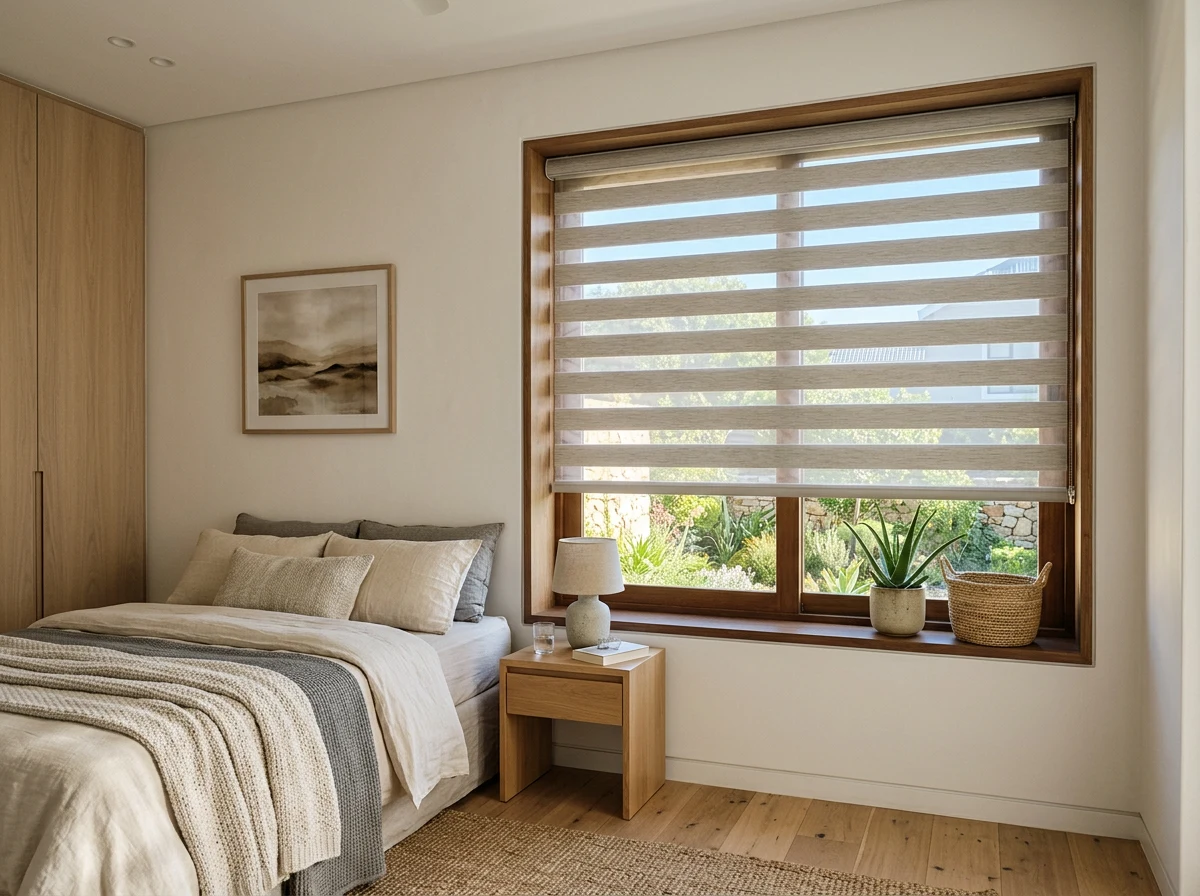
Day-night blinds
Alternating sheer and solid bands that slide past each other. View by day, privacy by night, one blind.
Explore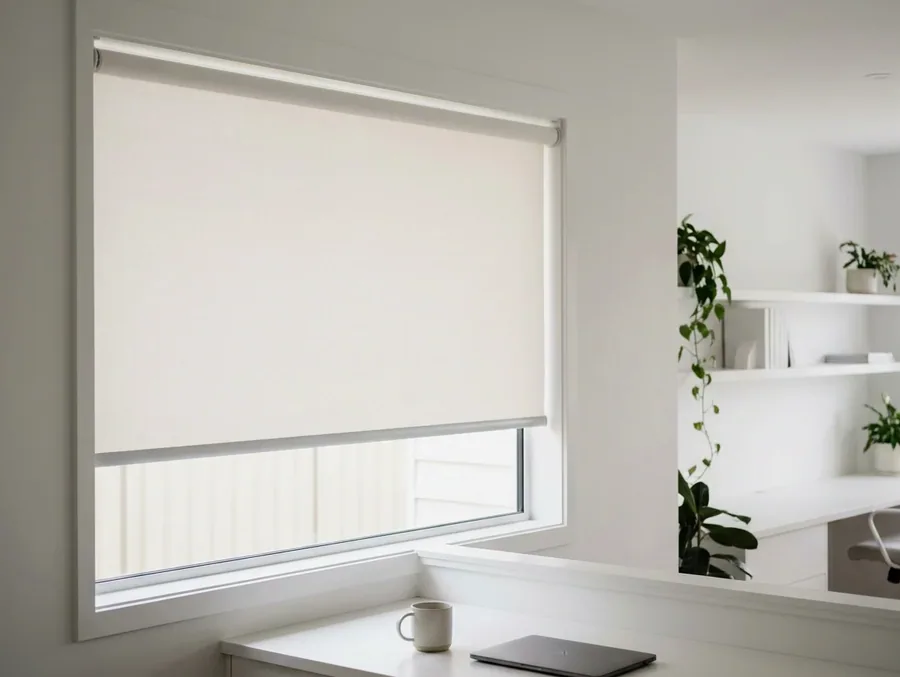
The tube does not care what hangs on it. What decides the room is the cloth: a coated blockout that stops light outright, or a woven sunscreen mesh that filters it while you carry on seeing through. Same bracket, same chain or motor, opposite results. Which is why “roller blinds, please” is not yet a specification — it is half of one.
On the Highveld the December sun is up before 05:30, and it lands first on the east-facing bedrooms. That is the whole blockout brief in one sentence. Coated fabric, opaque by construction, fitted to the rooms where sleep is the point: main bedroom, nursery, the television room that doubles as a Sunday-afternoon cinema.
Here is the part we would rather tell you before you pay than after. No roller hangs against the glass — there is always a few millimetres of daylight looking for the edges, and the deep reveals of Waterkloof's older houses give it a long edge to find. If nearly-dark is not dark enough, slim aluminium side channels close that gap; the fabric runs inside them and the halo goes. An extra component, an extra cost, and in a main bedroom, almost always the right call.
Stand in a ridge lounge in the late afternoon and the problem states itself: the glass faces the view, the view faces the sun. Nobody buys a house up here to roll a wall of blockout down over Pretoria. Sunscreen mesh is the compromise that is not really a compromise — an open weave, usually somewhere between 3% and 10%, that takes the glare and most of the UV out of the light while the city stays legible through it. Ask for 5% and you have asked for what most of your neighbours ended up with.
Colour is quietly a thermal decision, not a taste one. Pale mesh bounces heat back through the pane; dark mesh reads crisper to look through but soaks up more warmth itself. We bring both to the measure and hold them against your actual window, at the hour your room actually overheats.
At roughly 1,300m up, Highveld sun is hard on furnishings all year round, not just in summer. A mesh across a north or west window is doing bodyguard work for the rugs, artwork and yellowwood as much as for your eyes. Worth remembering when a room's problem is “everything in here is bleaching” rather than “I cannot see the television.”
Some rooms genuinely need the mesh by day and the dark by night. A double roller answers that with two tubes on one bracket — sunscreen in front, blockout behind, each doing only its own job. The single-blind alternative is a day-night blind, where sheer and solid bands slide past each other in one fabric; a different mechanism with its own trade-offs, covered on its own page.
Every chain we fit is tensioned and anchored to the wall. Standard, not an optional extra, and not something you need to remember to ask for. Where a window sits low, or the room belongs to children, we will push you towards a spring or a motor instead so there is nothing hanging at all. A rechargeable battery motor needs no wiring, which is what makes it an easy retrofit in a house whose plaster nobody wants to open.
On a standard tube, around two and a half metres before the fabric risks travelling sideways; on a heavier tube, wider. Past that we would rather link two or three blinds to one motor so a whole stack-door run moves as a single curtain of fabric — one button, no seam in the middle of the view.
Both, but honestly: an internal blind intercepts the sun after it has already passed through the glass, so part of the heat is in the room regardless. A pale sunscreen reflects a useful share back out; blockout stops the light but warms up doing it. On the ridge's hard north and west glass, the serious heat work is done outside the pane — that is the argument for external venetians or a roller shutter, with the roller as the indoor layer.
In the older houses here this is the first question, not the last. Inside the reveal keeps the joinery and the proportions on show and accepts a whisper of light at the edges; face-fitting over the opening is darker and hides more frame. We measure for both at the visit and tell you which one the window itself is voting for — out-of-square reveals, and 1903 gave Waterkloof plenty, sometimes settle the argument on their own.
Roller blinds are quoted per square metre, installed. Manual, on a chain or spring, in blockout, sunscreen or a light-filtering weave: R1,000 to R1,600 the square metre, with a double roller carrying two tubes on one bracket near the top of that. Motorised, the same opening comes to R2,500 to R3,800, which takes in the motor, the control and the linking of a stack-door run.
A small window is charged at a minimum rather than by area, because the tube, brackets and fitting visit are the same work at any width. Those are planning bands, not a quotation: each window is priced at the free measure and confirmed in writing before anything is made.
Often specified alongside
Alternating sheer and solid bands that slide past each other. View by day, privacy by night, one blind.
Explore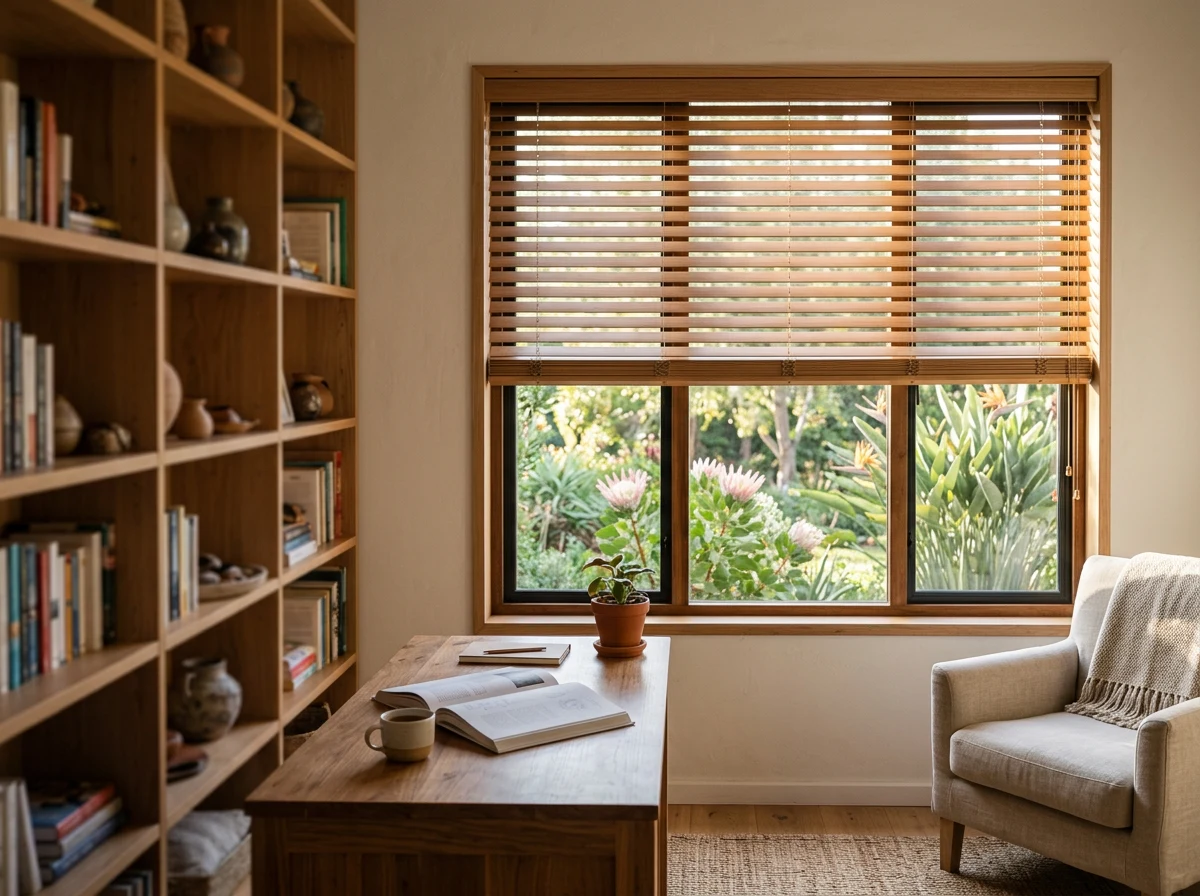
50mm basswood slats that tilt to steer light. The right answer in a room with proportions worth respecting.
Explore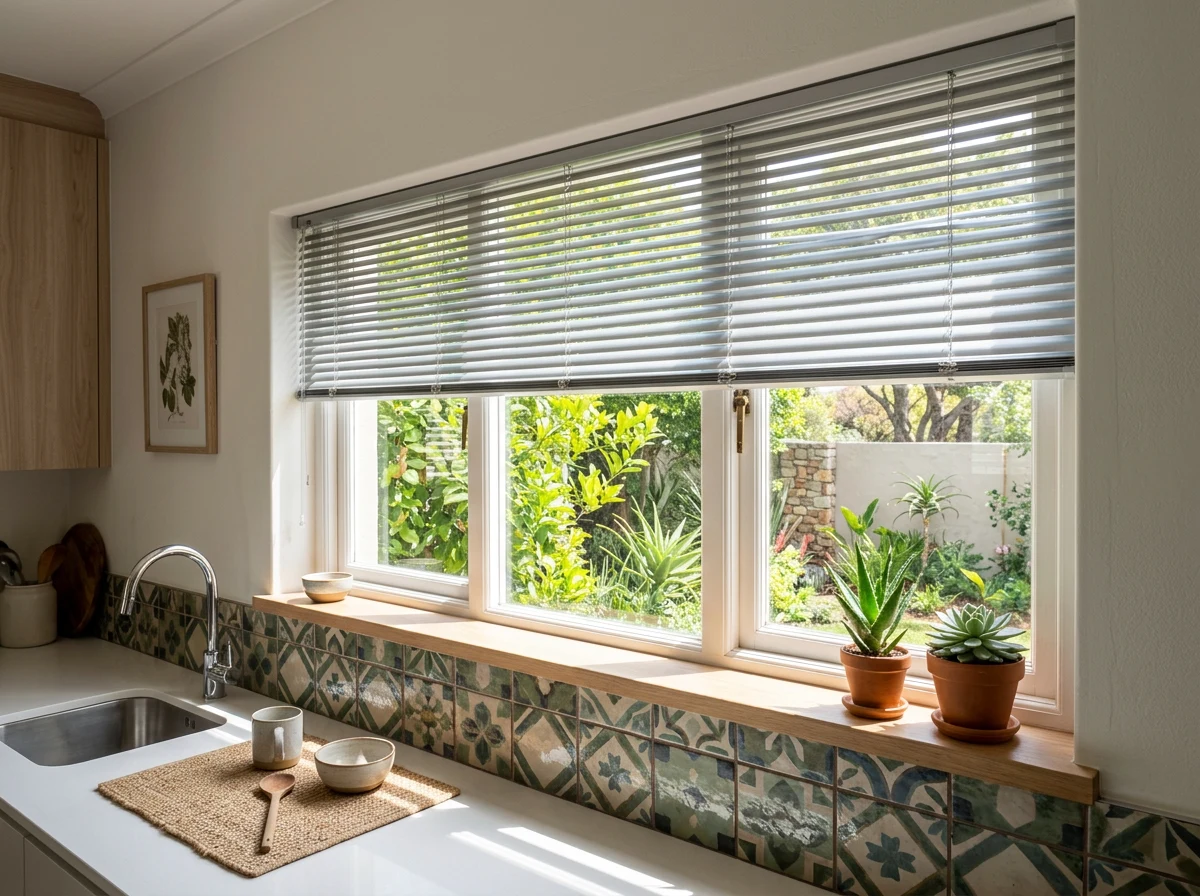
25mm or 50mm metal slats that shrug off steam and splashes. The practical venetian for kitchens and bathrooms.
ExploreWhere we fit it
Wherever we measure in the old east of Pretoria, a roller is usually somewhere on the quote — Waterkloof and the Ridge first, then Brooklyn, Groenkloof, Menlo Park and Hazelwood.
Next step
A free in-home measure, samples in your own light, and a written quote itemised per window. One of our expert consultants will contact you shortly.